When a LASIK or cataract patient asks AI which surgeon to trust, are you in the answer?
Patients weighing an eye surgeon increasingly start by asking an AI. Most eye practices are not named there yet. That is the opening: the practices that set up now are the ones AI will name. Run the free check and see, in about a minute, whether an AI engine names you, and who it names instead. Built for independent ophthalmology practices, not hospital systems.
Or go straight to a workup: the $149.99 AI Visibility Workup, or the $399 Practice Workup.
One-time $149.99. Your Scorecard is yours to keep.
We are the marketing layer for independent medicine.
We start by telling you exactly where you stand: free for the headline, scored for the why, the full read for the whole picture and a plan. One thing runs through all of it: a diagnostic you own, not a retainer you renew.
One honest answer: does an AI name you when a patient asks?
- We ask one engine the real question a patient would
- A straight yes or no, in plain language
- No account, no card
Your Scorecard across all five engines, back in minutes.
- All five engines scored: ChatGPT, Claude, Gemini, Perplexity, Google AI Overview
- A composite AI Visibility Score, 0–100
- Who gets named instead, on each engine
- A booking simulation: how a patient actually finds you
The full read of your whole local and AI presence.
- Your AI visibility across all five engines, scored
- Demand, reviews, and the competitors patients see instead
- A sequenced 30/60/90 plan you keep
We rank your top services by value and demand, then build the FAQ schema AI engines cite.
- Your top six services, ranked by ROI and real demand
- Paste-ready FAQPage schema for any CMS
- A branded report, delivered within the hour
Step through at your own pace. Stop wherever the answer is enough.
Choosing an eye surgeon split into two channels.
There’s the Google search you know. And a newer one, where a patient describes blurry vision, a cataract, or the LASIK result they want, and just asks an AI who to see. Both decide who gets the call.
Most eye practices have the first covered. The second is where LASIK and cataract patients increasingly start, and it is still unclaimed; the first step is finding out where you stand.
“Best LASIK surgeon near me?”
“I’d recommend…” the practice that set up for AI first
The way patients find an eye surgeon is changing in real time.
of patients have used AI to find a new provider as of mid-2026, up from 31% six months earlier.1
TechTarget, 2026
people use ChatGPT for health questions every day. More than 5% of everything it is asked is healthcare.2
OpenAI, January 2026
cataract surgeries are performed in the US each year, the most common surgery in medicine, and the patients choosing a surgeon verify everything first.3
NIH / practice-patterns survey
The demand already exists in your metro, and vision questions are among the most asked of all. The free check shows you where you stand.
Google AI Overview, ChatGPT, Perplexity, Gemini, and Claude, asked the questions your patients actually type.
60% of the readReal SERP rankings, captured the day of your workup, plus the keyword demand behind your metro. Not a cached estimate.
where you rank nowThe review signal AI reads when it decides who to cite: your velocity, your themes, your directory consistency.
the source materialYour real independent competitors, derived from who AI actually cites and who ranks, not keyword guesses.
who you're up againstEvery figure is scoped to your metro area, the region your patients actually drive from (your Nielsen DMA), and sourced inside the report.
What every workup has inside.
The Execution Brief
The same findings and 90-day plan with financial data redacted, ready to hand to a developer or agency.
Delivered within an hour
Submit your URL and the workup runs. Your report opens in a new tab and lands in your inbox.
Built for ophthalmology
We benchmark you against the independent practices you actually compete with, calibrated to ophthalmology. The field as it really is.
A 30/60/90 plan, not a problem list
Every gap becomes a sequenced action across 30, 60, and 90 days, each with an owner and an effort estimate.
Three steps. One submission. One report.
No discovery call. No back-and-forth. Submit your URL, watch the workup run, and your branded report opens in a new tab.
A diagnostic you own. Not a retainer you renew.
One honest price, paid once
A read that is yours to keep, share, and act on
A plan you can hand to any team, or run yourself
Nothing recurring, nothing to log into, nothing to cancel
We sell you a clear picture of where you stand and what is worth fixing. If a fix is worth handing to us, we will say so. If you can do it yourself, we will say that too.
Is your ophthalmology practice showing up in AI search?
Know where you stand. Be the ophthalmology practice AI names.
Your next patient is going to search. They will also ask an AI. We measure what both channels say about your practice: free if you want only the headline, scored if you want the why. The field is open, and the practices that start now get to own it.
Run your free checkOr go straight to the $149.99 AI Visibility Workup or the $399 Practice Workup.
If you’d rather talk it through, that’s what we’re here for. Read how we work together, or write me directly: kenny@webeverything.com.
Kenny Gimpert, Founder
And if this isn’t the marketing help you’re looking for, we also build custom marketing systems for practices: see Marketing Engineering.
- TechTarget, 2026. Share of patients who have used AI to find a new provider (47%, up from 31% six months earlier).
- OpenAI, January 2026. Daily ChatGPT health-question usage (40M+; more than 5% of all queries are healthcare). From the “AI as a Healthcare Ally” report.
- Cataract surgery practice patterns worldwide (NIH/PMC). An estimated 3.7 million cataract procedures per year in the US, the most prevalent surgical procedure across specialties.
Plain-language definitions of the terms we use live in our glossary.
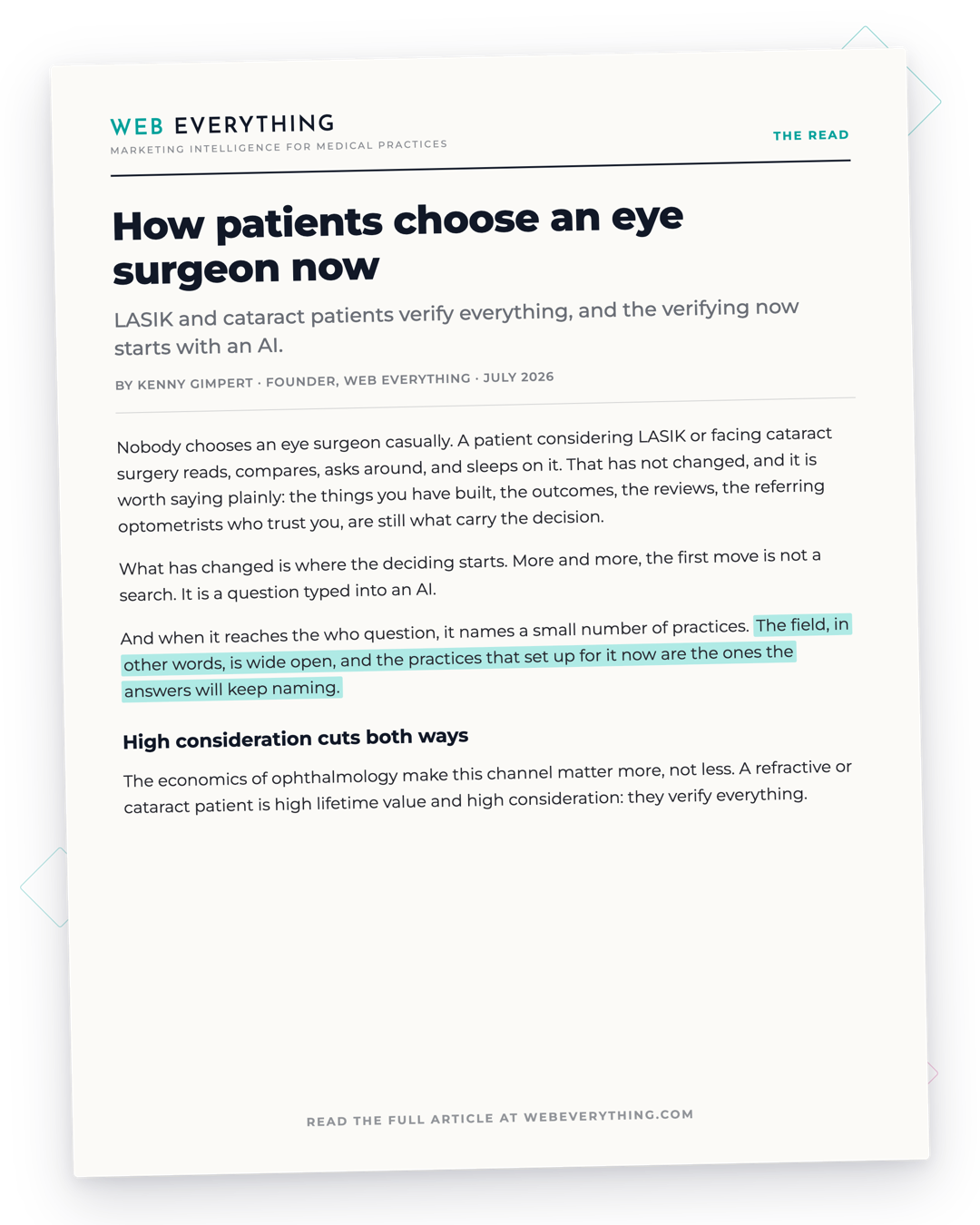
How patients choose an eye surgeon now
The highest-consideration patients in medicine now start with a question to an AI. Most eye practices are not in the answer yet, and that is the opportunity, not the problem.
Read the article →Built on Trust.
How we determine the market you actually compete in, and why what we learn stays yours.
DMA-level intelligence.
Every workup resolves to the Nielsen DMA your practice actually competes inside, the metro your patients really drive from.
Public data only. No PHI, ever.
We read what your patients can read: your website, Google, directories, social profiles. We never request or process patient information.
Your data, your report.
We do not sell or share your findings. Your workup is yours.
Licensed market data.
Search volumes from Google Ads keyword data, live rankings captured at workup time, every figure sourced inside the report.
Questions about how we handle data? Email hello@webeverything.com.